Customer acquisition cost (CAC) is what you spend, on average, to win one new customer. It is one of the most useful numbers for any business that advertises, because it tells you whether growth is profitable – especially when you compare it with how much a customer is worth over time.
The CAC formula
CAC = Total sales and marketing costs ÷ Number of new customers (same period)
Example
in March a shop spends $12,000 on ads, $2,000 on marketing software and $6,000 on a marketing assistant’s wages – $20,000 in total – and wins 400 new customers. CAC = $20,000 ÷ 400 = $50.
What to include
- Ad spend on every platform
- Agency, freelancer and content costs
- Marketing and sales salaries (the share spent on acquisition)
- Tools and software used for marketing
- Discounts and referral rewards given to new customers
Count only new customers – repeat orders from existing customers belong in retention, not acquisition.
Blended CAC vs paid CAC
Blended CAC divides all acquisition costs by all new customers, including those who found you through search, word of mouth or social posts. Paid CAC divides only ad spend by the customers attributed to ads. In the example above, if ads are credited with 200 of the 400 customers, paid CAC is $12,000 ÷ 200 = $60, while blended CAC is $50. Both are useful: blended CAC shows overall efficiency; paid CAC shows whether a specific channel is worth scaling.
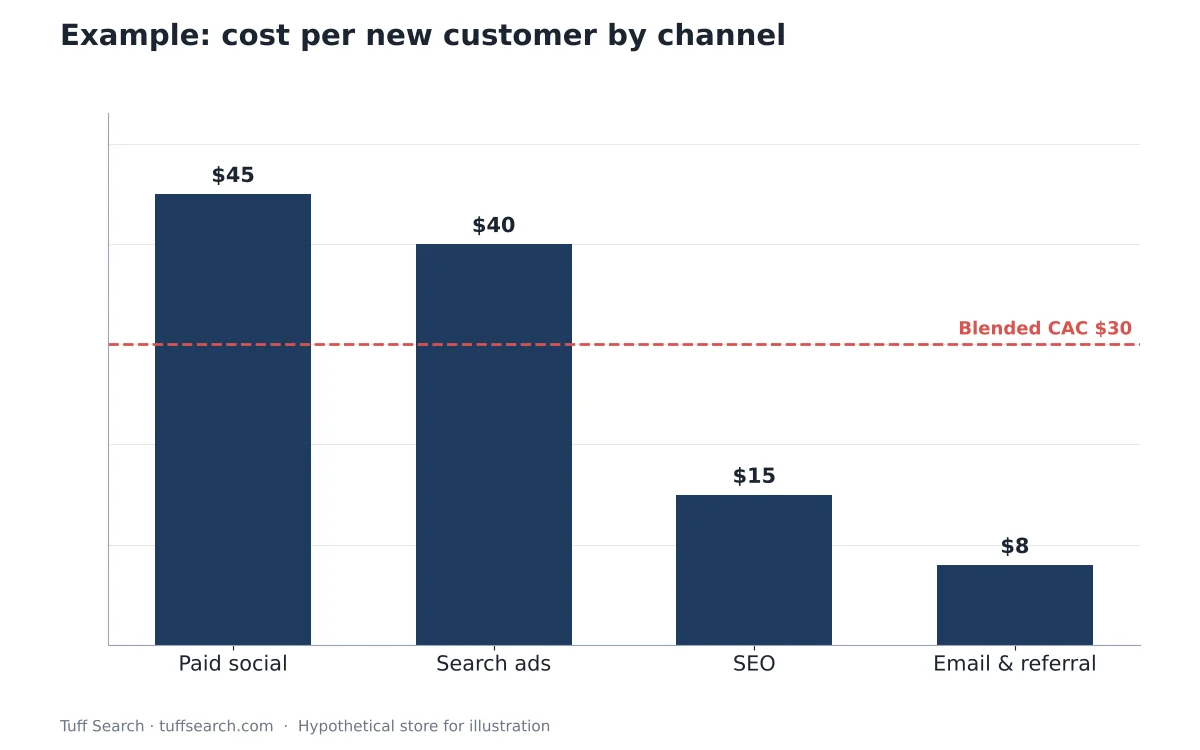
Channel figures in the chart are a made-up example. Your own numbers will differ by product, market and season – measure them from your ad accounts and analytics.
Try it with your numbersFacebook Ads Cost CalculatorPlan a Facebook and Instagram ads budget from your own CPM, CTR and conversion rate, and estimate reach, clicks, leads…Open calculatorCAC vs CPA vs ROAS
- CPA (cost per acquisition) is usually measured inside an ad platform and counts any conversion – a purchase, lead or sign-up – not necessarily a new customer.
- ROAS (return on ad spend) is revenue ÷ ad spend. It links to CPA through average order value: ROAS = AOV ÷ CPA. An $80 average order and a $20 cost per purchase give a ROAS of 4.
- CAC is the business-level view: all acquisition costs per genuinely new customer.
The Facebook ads cost calculator turns a budget into clicks, conversions and CPA, and the ROAS calculator shows your break-even return.
Comparing CAC with customer lifetime value
A $50 CAC is cheap if a customer buys for years and expensive if they buy once. Customer lifetime value (LTV or CLV) estimates the gross profit a customer brings in over the relationship:
LTV (gross profit) = Average order value × Orders per year × Years as a customer × Gross margin
Example
$80 average order, 3 orders a year, 2 years, 40% gross margin: LTV = 80 × 3 × 2 × 0.40 = $192. With a $50 CAC, the LTV:CAC ratio is 192 ÷ 50 = 3.8.
Many growth teams treat an LTV:CAC ratio of about 3:1 as a healthy rule of thumb – each customer returns roughly three times what it cost to win them. Below 1:1 you lose money on every customer; a very high ratio can mean you are under-investing in growth. Treat any benchmark as a starting point, not a rule.
CAC payback period
CAC payback (months) = CAC ÷ Monthly gross profit per customer
A subscription costs $30 a month with an 80% gross margin, so each customer brings $24 of gross profit a month. If CAC is $120, payback takes 120 ÷ 24 = 5 months. The shorter the payback, the less cash you need to fund growth.
How to lower CAC
- Raise conversion rates on your website – the same traffic then produces more customers.
- Improve ad creative and targeting to lift click-through rates.
- Invest in channels with low marginal cost, such as SEO and email. Measure them with the SEO ROI calculator.
- Encourage referrals and reviews from happy customers.
- Raise average order value with bundles, which improves the return on every acquisition.
Common mistakes
- Counting returning customers as new, which makes CAC look lower than it is.
- Leaving out salaries, tools or agency fees.
- Comparing CAC with revenue per customer instead of gross profit.
- Judging a channel by one month of data when sales take weeks to close.
Before you set a budget, read how to set a small business marketing budget and check your margins with markup vs margin.
Frequently asked questions
Divide total sales and marketing costs for a period by the number of new customers won in that period. $20,000 and 400 new customers gives a CAC of $50.
About 3:1 is a widely used rule of thumb. Below 1:1 means each customer costs more to win than they bring in.
CPA is usually a platform metric for any conversion; CAC counts all acquisition costs per genuinely new customer.
The number of months of gross profit from a customer needed to recover what it cost to acquire them.
Related calculators
- Facebook Ads Cost Calculator
- ROAS Calculator
- SEO ROI Calculator
- LinkedIn Ads Budget Calculator
- TikTok Ads Budget Calculator