Markup and margin both describe profit as a percentage, so they are easy to mix up – and the mix-up is expensive. Price a product with a 40% markup when you meant a 40% margin and your real margin is only 28.6%. This guide explains both, how to convert between them and how to set prices that hit the margin you need.
The two formulas
Margin = (Price − Cost) ÷ Price × 100 | Markup = (Price − Cost) ÷ Cost × 100
Both use the same profit (price − cost). Margin divides it by the selling price; markup divides it by the cost. Because price is always larger than cost for a profitable product, margin is always the smaller number.
Example
You buy a product for $60 and sell it for $100. Profit is $40.
- Margin = $40 ÷ $100 = 40%
- Markup = $40 ÷ $60 = 66.7%
Converting markup to margin and back
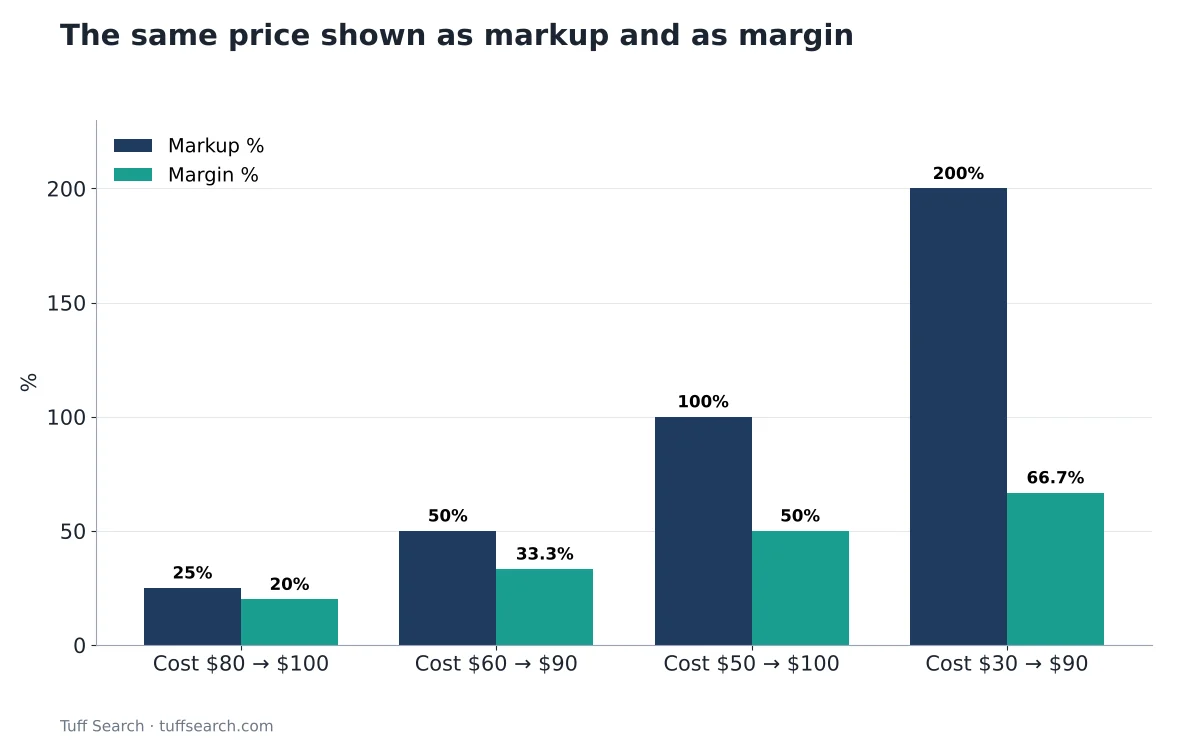
Margin = Markup ÷ (1 + Markup) | Markup = Margin ÷ (1 − Margin)
Use decimals in these formulas (50% = 0.5). A 50% markup is 0.5 ÷ 1.5 = 33.3% margin. A 50% margin needs a markup of 0.5 ÷ 0.5 = 100%.
| Markup | Margin | Margin | Markup needed | |
|---|---|---|---|---|
| 20% | 16.7% | 10% | 11.1% | |
| 25% | 20.0% | 20% | 25.0% | |
| 50% | 33.3% | 30% | 42.9% | |
| 75% | 42.9% | 40% | 66.7% | |
| 100% | 50.0% | 50% | 100.0% | |
| 150% | 60.0% | 60% | 150.0% | |
| 200% | 66.7% | 70% | 233.3% |
How to price for a target margin
Price = Cost ÷ (1 − Target margin)
To make a 40% margin on a $60 product: $60 ÷ (1 − 0.40) = $60 ÷ 0.60 = $100.
The common mistake is to multiply cost by 1.4 instead: $60 × 1.4 = $84. The profit is $24 and the margin is $24 ÷ $84 = 28.6% – well short of 40%. On $100,000 of sales, that gap is more than $11,000 of gross profit.
Which should you use?
- Retailers and wholesalers often set prices with markup because it starts from the cost they know.
- Accounts, investors and most performance targets use margin, because it shows how much of each sales dollar you keep.
- For advertising decisions, margin is the number that matters: your break-even ROAS is 1 ÷ gross margin.
Whichever you use internally, label it clearly. “40%” on a price list means very different things to a buyer and an accountant.
Gross margin vs net margin
Gross margin uses only the direct cost of the product (cost of goods sold). Net margin also subtracts operating costs such as wages, rent, software, payment fees and advertising. A product with a healthy 50% gross margin can still lose money once a 3% payment fee, shipping and ad costs are counted. The Shopify fee calculator shows how platform and card fees eat into each order, and the labour cost calculator helps you include staff costs.
Margin and advertising
Your margin sets how much you can afford to pay for a sale. With a 40% gross margin, a $90 order brings $36 of gross profit, so paying more than $36 in ads to win it loses money on the first order. That is the same as a break-even ROAS of 2.5. Check any campaign against your own margin with the ROAS calculator, and see how customer acquisition cost works.
Quick checklist
- Decide whether you are working in markup or margin – and write it down.
- Use Price = Cost ÷ (1 − margin) when you need a target margin.
- Include all direct costs in “cost”: product, inbound shipping, packaging.
- Check net margin after fees, shipping and advertising.
Frequently asked questions
Markup is profit as a percentage of cost; margin is profit as a percentage of the selling price. For a $60 item sold at $100, markup is 66.7% and margin is 40%.
No. A 50% markup gives a 33.3% margin. A 50% margin needs a 100% markup.
Divide the cost by (1 − margin as a decimal). For a 30% margin on a $70 cost: $70 ÷ 0.70 = $100.
Both use the same profit, but margin divides by the price, which is larger than the cost that markup divides by.