

Asphalt is ordered by weight, but jobs are measured by area. To bridge the two you need the area, the compacted thickness and the density of the mix. With those three numbers you can estimate tonnage before you call a supplier.
The asphalt tonnage formula
Tons = Area (sq ft) × Thickness (in) ÷ 12 × Density (lb/ft³) ÷ 2,000
Dividing thickness by 12 converts inches to feet, so area × thickness gives cubic feet. Multiplying by density gives pounds, and dividing by 2,000 gives U.S. (short) tons.
What density to use
Compacted hot-mix asphalt is commonly estimated at about 145 pounds per cubic foot (roughly 2.32 metric tonnes per cubic metre). Actual density depends on the mix design and compaction, so ask your supplier for the figure they use.
Try it with your numbersAsphalt CalculatorEstimate asphalt tonnage from length, width, thickness and density (145 lb/ft³ default), plus waste and cost.Open calculatorExample: 1,000 sq ft driveway
- Area: 1,000 sq ft (for example 50 ft × 20 ft).
- Thickness: 2 in → 2 ÷ 12 = 0.1667 ft.
- Volume: 1,000 × 0.1667 = 166.7 cubic feet.
- Weight: 166.7 × 145 = 24,167 lb.
- Tons: 24,167 ÷ 2,000 ≈ 12.1 tons.
At 3 inches thick the same area needs about 18.1 tons. Add a waste allowance, often around 5 to 10%, for edges, uneven base and handling.
Metric example
100 m² at 50 mm thick: 100 × 0.05 = 5 m³; 5 × 2.32 = 11.6 tonnes.
Quick reference table
| Area | 2 in thick | 3 in thick | 4 in thick |
|---|---|---|---|
| 250 sq ft | 3.0 t | 4.5 t | 6.0 t |
| 500 sq ft | 6.0 t | 9.1 t | 12.1 t |
| 1,000 sq ft | 12.1 t | 18.1 t | 24.2 t |
| 2,000 sq ft | 24.2 t | 36.3 t | 48.3 t |
Values use 145 lb/ft³ and do not include waste.
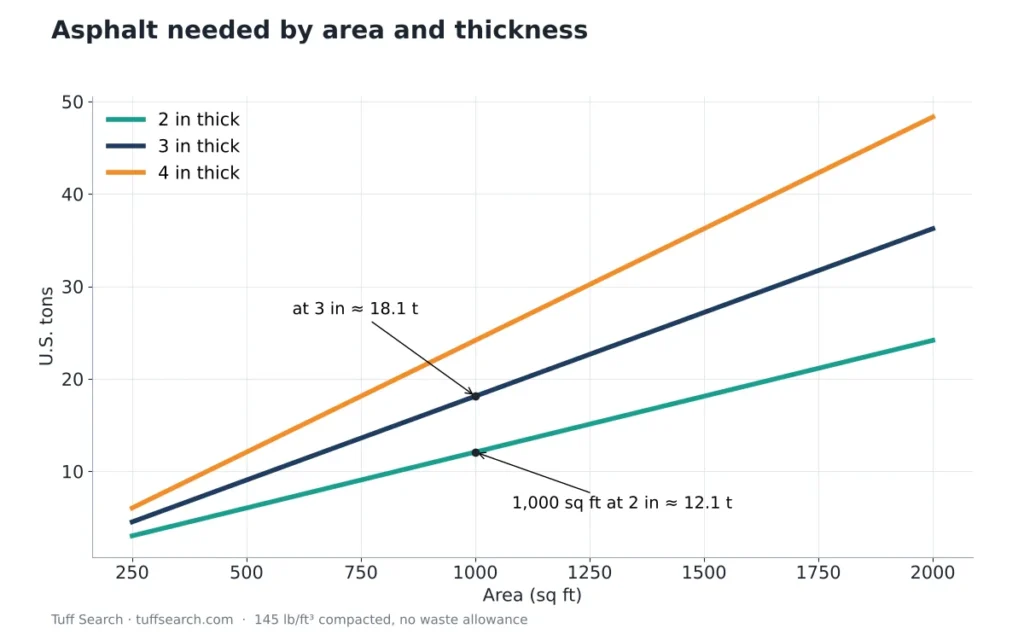
Tons of hot-mix asphalt by area and thickness, using 145 lb per cubic foot.
Choosing a thickness
Residential driveways are often laid at about 2 to 3 inches of compacted asphalt over a well-prepared aggregate base, while areas carrying heavier vehicles need more. Local codes and your contractor’s assessment of soil and drainage should decide the final specification.
Measuring irregular areas
- Split the area into rectangles, triangles and circles, calculate each, then add them.
- Rectangle: length × width. Triangle: base × height ÷ 2. Circle: 3.1416 × radius².
- Measure in feet (or metres) before you start to avoid mixing units.
Calculate your job
Enter your dimensions in the asphalt calculator to get tons and a waste allowance instantly. Browse other construction calculators for related jobs.
Frequently asked questions
About 12.1 tons at 2 inches thick and 18.1 tons at 3 inches, using 145 lb per cubic foot, before waste.
At 145 lb per cubic foot, a cubic yard (27 cubic feet) weighs about 3,915 lb, or roughly 1.96 tons.
Tonnage estimates use the compacted thickness. Loose material is laid thicker and rolled down.
Many estimators add about 5 to 10% for waste. Ask your contractor what allowance they use.
Related calculators
Related articles
- Asphalt Driveway Maintenance: Sealing, Cracks & Care
- How to Calculate Take-Home Pay From Your Salary (2026)
- 2026 Federal Income Tax Brackets Explained With Examples


