
To add or subtract fractions with different denominators, you need a common denominator – and the least common denominator (LCD) keeps the numbers as small as possible. The LCD is simply the least common multiple (LCM) of the denominators. Here are three ways to find it.
Method 1: List the multiples
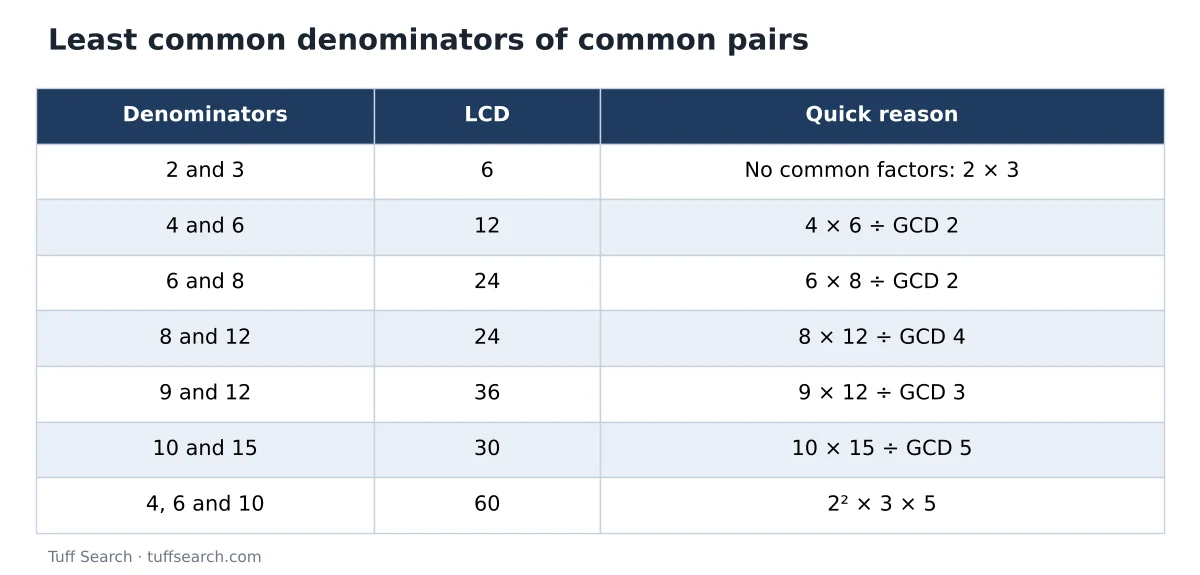
Write out multiples of each denominator until you find the first one they share. For 4 and 6: multiples of 4 are 4, 8, 12, 16…; multiples of 6 are 6, 12, 18…. The first shared multiple is 12, so the LCD is 12. This works well for small numbers.
Method 2: Prime factorisation
- Break each denominator into prime factors.
- For each prime, take the highest power that appears in any of the numbers.
- Multiply those together.
Example
12 = 2² × 3 and 18 = 2 × 3². Take 2² and 3²: LCD = 4 × 9 = 36. This method is the most reliable for larger numbers and for three or more denominators.
Method 3: The GCD shortcut
LCD(a, b) = a × b ÷ GCD(a, b)
First find the greatest common divisor (GCD) – the largest number that divides both. For 8 and 12 the GCD is 4, so LCD = 8 × 12 ÷ 4 = 24. If the two numbers share no factors (like 7 and 9), the LCD is just their product, 63.
Worked example: adding fractions
5/6 + 3/8. LCD of 6 and 8 is 24. Rewrite: 5/6 = 20/24 (×4) and 3/8 = 9/24 (×3). Add: 20/24 + 9/24 = 29/24, or 1 5/24 as a mixed number.
Three or more fractions
Find the LCD of all the denominators at once with prime factors. For 1/4 + 1/6 + 1/10: 4 = 2², 6 = 2 × 3, 10 = 2 × 5, so LCD = 2² × 3 × 5 = 60. Then 1/4 = 15/60, 1/6 = 10/60 and 1/10 = 6/60, giving 31/60.
LCD vs GCD – don’t mix them up
- The LCD (least common multiple) is the smallest number both denominators divide into – used to add and subtract fractions.
- The GCD (greatest common divisor) is the largest number that divides both – used to simplify fractions.
- For 8 and 12: LCD 24, GCD 4.
Common mistakes
- Using any common denominator (like multiplying the denominators) is not wrong, but it makes larger numbers to simplify later.
- Forgetting to multiply the numerator by the same factor as the denominator.
- Adding denominators together – 1/2 + 1/3 is 5/6, not 2/5.
Fractions, decimals and percentages are closely linked – our guide on how to calculate percentages shows how to convert between them, and perfect squares and square roots uses the same prime factor skills. For decimals, the rounding calculator rounds to any place.
Frequently asked questions
The smallest number that all the denominators divide into exactly – the least common multiple of the denominators.
Factor each denominator into primes and multiply the highest power of each prime. For 4, 6 and 10 it is 60.
Yes – the LCD is the LCM of the denominators.
24.
No, any common denominator works, but the least one keeps the numbers smaller and reduces simplifying.
Related calculators
Related articles
- How to Calculate Percentages: 6 Formulas With Worked Examples
- Perfect Squares and Square Roots: Chart, Estimation and Simplifying
- Midpoint Formula Explained With Step-by-Step Examples