Surface area is the total area of everything on the outside of a 3D shape – what you would need to paint it, wrap it or cover it. For any shape made of flat faces you can find it by adding the area of each face; for round shapes there are short formulas.
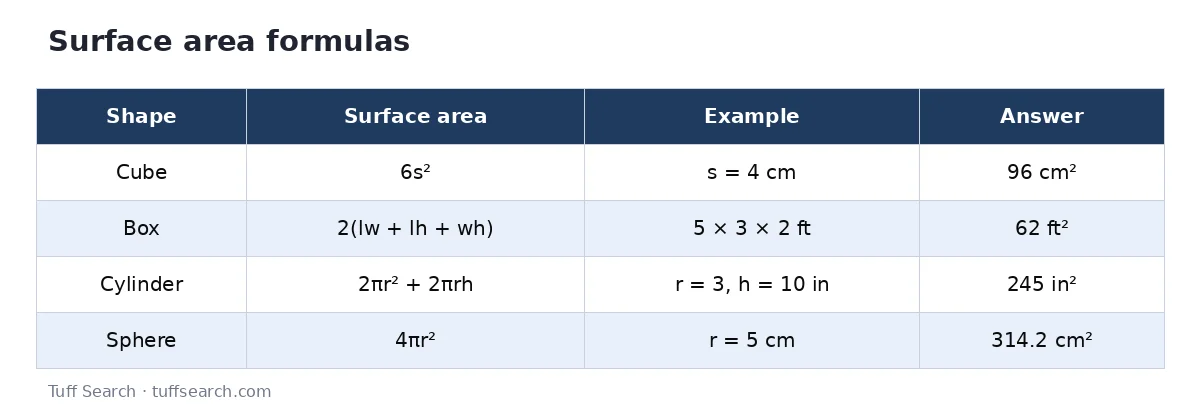
Surface area formulas
| Shape | Surface area | Example | Answer |
|---|---|---|---|
| Cube | 6s² | s = 4 cm | 96 cm² |
| Rectangular box | 2(lw + lh + wh) | 5 × 3 × 2 ft | 62 ft² |
| Cylinder | 2πr² + 2πrh | r = 3, h = 10 in | 245 in² |
| Sphere | 4πr² | r = 5 cm | 314.2 cm² |
| Cone | πr² + πrl (l = slant height) | r = 3, l = 5 | 75.4 |
| Square pyramid | b² + 2bl | b = 6, l = 5 | 96 |
The net method
Unfold the shape into a flat pattern (a net) and add the areas of the pieces. A box opens into six rectangles in three matching pairs: 5 × 3 twice, 5 × 2 twice and 3 × 2 twice, giving 30 + 20 + 12 = 62 square feet. A cylinder unrolls into two circles and one rectangle whose width is the circumference.
Cylinder step by step
- Area of the two circular ends: 2 × π × r².
- Area of the curved side: circumference × height = 2πr × h.
- Add them.
For r = 3 in and h = 10 in: 2π × 9 ≈ 56.5 plus 2π × 3 × 10 ≈ 188.5, total ≈ 245 square inches. For an open can (no lid), subtract one circle.
Surface area vs volume
Surface area is measured in square units and tells you how much material covers the outside. Volume is in cubic units and tells you how much fits inside. Paint, wrapping paper and sheet metal depend on surface area; water, soil and concrete depend on volume.
Why shape matters
For a given volume, a sphere has the smallest surface area of any shape, which is why bubbles are round. Small objects have a lot of surface for their size, so a crushed ice cube melts faster than a whole one and small animals lose heat faster than large ones.
Real-world uses
- Paint: the four walls of a 12 × 15 ft room with 8 ft ceilings are 2 × (12 + 15) × 8 = 432 sq ft before subtracting doors and windows.
- Packaging: the cardboard needed for a box is its surface area plus flaps.
- Insulating a tank or pipe: use the cylinder’s curved area.
Common mistakes
- Using the radius where a formula needs the diameter, or vice versa.
- Forgetting the ends of a cylinder or the base of a cone.
- Using height instead of slant height for cones and pyramids.
- Giving surface area in cubic units.
Worked example: painting a cylindrical tank
A water tank is 4 ft across (r = 2 ft) and 6 ft tall, and you will paint the side and top but not the base. Side: 2π × 2 × 6 ≈ 75.4 sq ft. Top: π × 2² ≈ 12.6 sq ft. Total ≈ 88 sq ft. If a gallon covers about 350 sq ft per coat, two coats need roughly 0.5 gallons – one gallon is enough.
Converting units
Square units convert by the square of the length factor: 1 ft² = 144 in², 1 m² = 10,000 cm², and 1 yd² = 9 ft². Convert lengths before you calculate if your measurements are in mixed units – it avoids most conversion errors.
Frequently asked questions
The total area of all the outside surfaces of a 3D shape.
2πr² + 2πrh.
4πr².
Square units such as cm² or ft².
Surface area covers the outside; volume measures the space inside.