
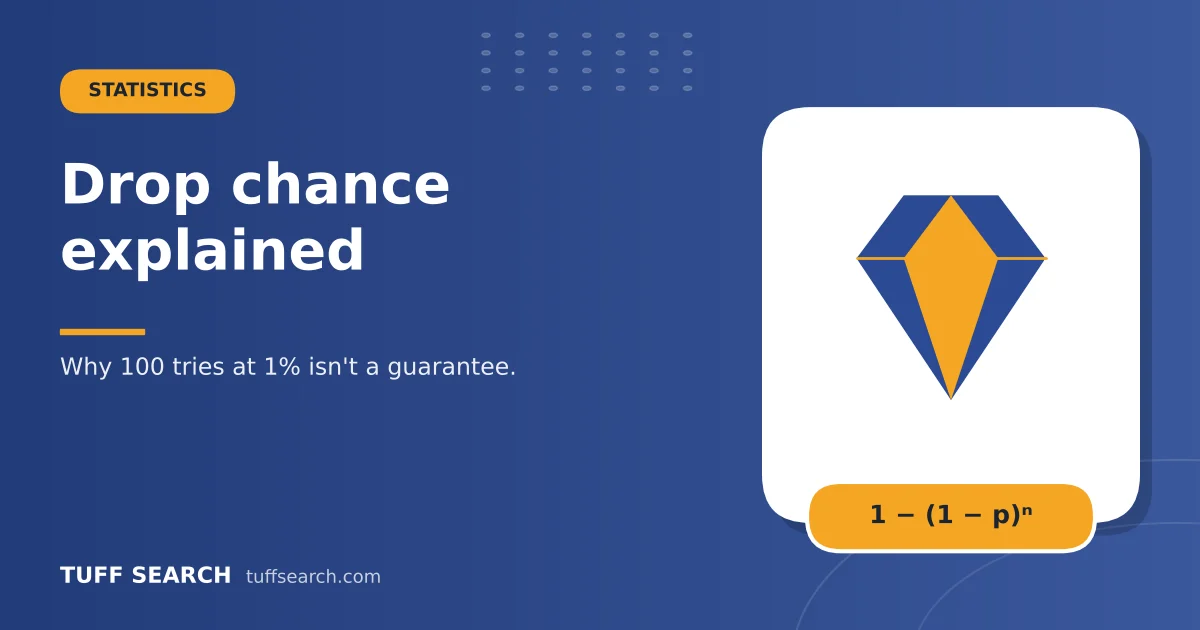
A game says an item has a 1% drop rate, so after 100 tries you should have it, right? Not quite. After 100 tries you have about a 63% chance. Understanding why helps you plan farming time and avoid frustration.
The formula
Chance of at least one drop = 1 − (1 − p)ⁿ
Here p is the drop rate as a decimal (1% = 0.01) and n is the number of attempts. The term (1 − p)ⁿ is the chance of missing every single time, so subtracting it from 1 gives the chance of succeeding at least once.
Worked example: 1% drop, 100 tries
- Chance of missing once: 1 − 0.01 = 0.99
- Chance of missing 100 times in a row: 0.99¹⁰⁰ ≈ 0.366
- Chance of at least one drop: 1 − 0.366 ≈ 0.634, or 63.4%
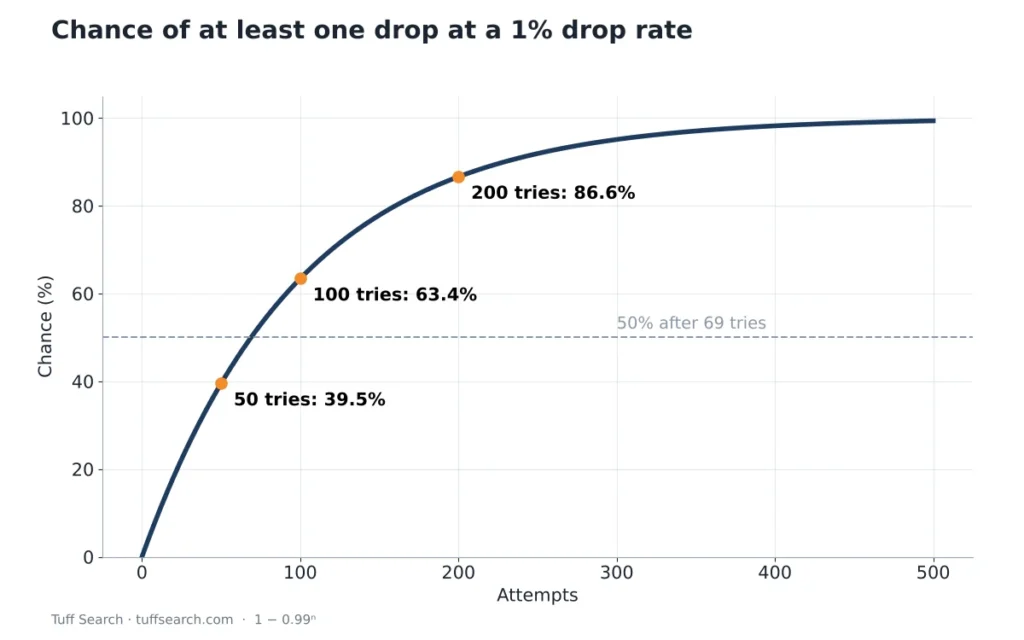
Chance of getting at least one drop with a 1% rate, by number of attempts.
Try it with your numbersDrop Chance CalculatorCalculate your chance of getting a drop after N attempts, the attempts needed for a target probability and dry-streak…Open calculatorHow many attempts do you need?
Rearranging the formula gives the attempts needed for a target probability:
n = ln(1 − target) ÷ ln(1 − p), rounded up
| Target chance (1% drop) | Attempts needed |
|---|---|
| 50% | 69 |
| 90% | 230 |
| 95% | 299 |
| 99% | 459 |
Why 100 tries isn’t a guarantee
Each attempt is independent. The game does not remember your earlier failures, so the chance on attempt 101 is still 1%. This is also why you might get lucky on your second try while a friend goes 300 attempts without a drop. Both outcomes are normal.
The gambler’s fallacy
Feeling that a drop is “due” after a long dry streak is the gambler’s fallacy. Past misses do not raise the chance of the next attempt, unless the game uses a pity system that deliberately increases the rate after failures. If it does, the simple formula no longer applies.
Average attempts vs likely attempts
On average a 1% drop takes 100 attempts, but the median is only 69. The average is pulled up by unlucky long streaks. If you want to know what most players experience, the median is the more useful number.
Calculate your drop
Enter any rate and number of tries in the drop chance calculator, or explore more statistics calculators.
Frequently asked questions
About 63.4%. The formula is 1 − 0.99¹⁰⁰.
69 attempts give just over a 50% chance.
Not in a normal random system. Each attempt has the same chance unless the game adds a pity timer.
This formula is for at least one drop. For an exact number of drops you need the binomial distribution.