What Is Cardiac Output?
Cardiac output is the total volume of blood your heart pumps per minute. It measures how efficiently your cardiovascular system delivers oxygen and nutrients to every tissue in your body. Doctors use it as one of the most reliable indicators of ventricular function and overall heart health. Furthermore, it sits at the centre of hemodynamics the study of how blood moves through the circulatory system.
A healthy heart continuously adjusts its output based on demand. During rest, your body needs less. During exercise or illness, demand rises sharply. Consequently, your heart responds by changing either how fast it beats, how much blood it pushes with each beat, or both.
The Cardiac Output Formula
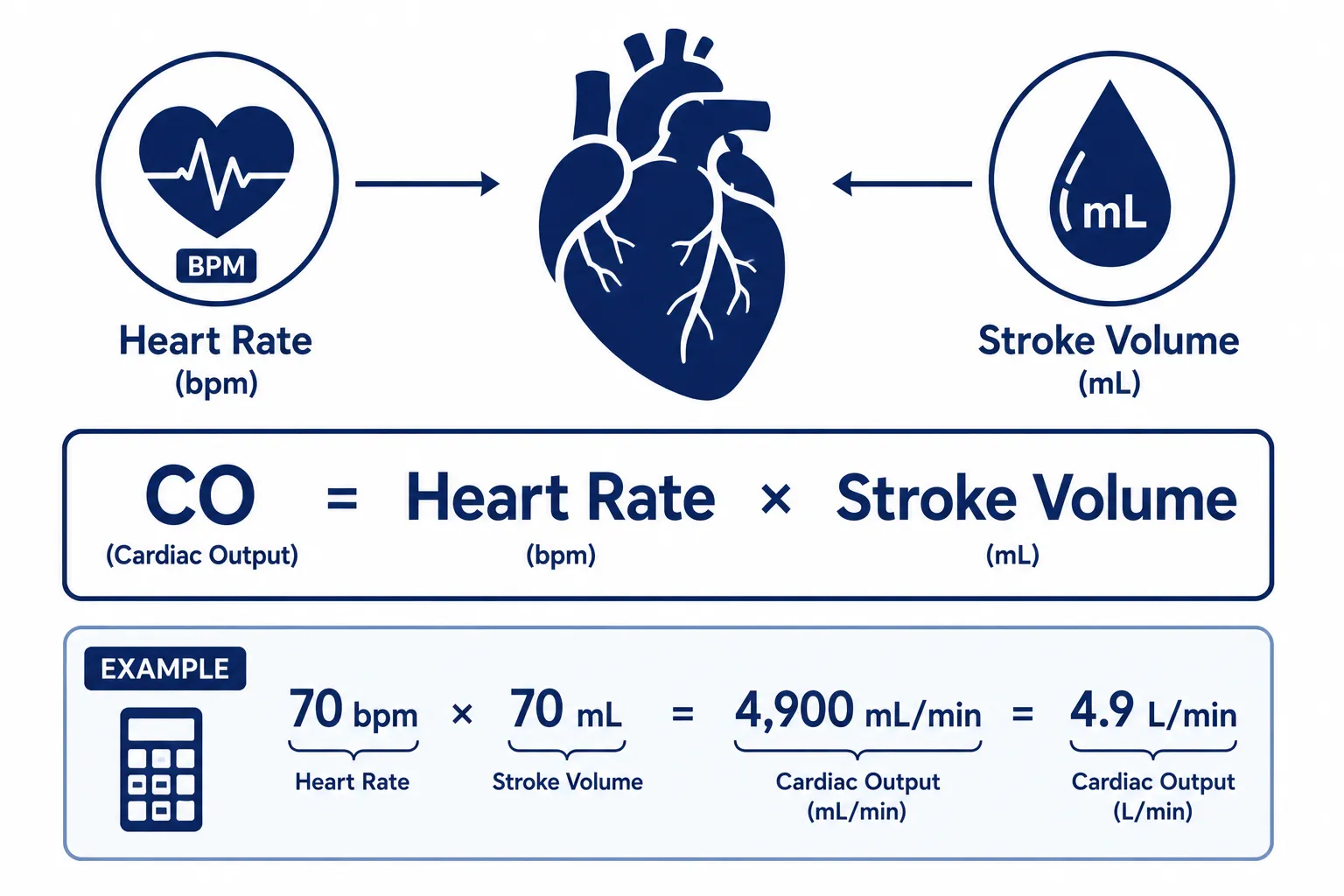
The cardiac output formula is one of the most straightforward in cardiovascular medicine. It relies on two variables that you can measure without specialist equipment:
Cardiac Output (CO) = Heart Rate (HR) × Stroke Volume (SV)
Heart rate is the number of beats per minute. Stroke volume is the amount of blood your left ventricle ejects with each beat, measured in millilitres. Therefore, if your heart beats 70 times per minute and ejects 70 mL per beat: 70 × 70 = 4,900 mL/min, or roughly 4.9 L/min a perfectly normal result for a resting adult.
Heart Rate and Stroke Volume The Two Drivers
Every change in cardiac output traces back to heart rate and stroke volume. Both drivers respond to the same signals physical exertion, emotional stress, body position, and hydration but they respond differently. Understanding each one separately helps you interpret your calculator result with real precision.
- Heart rate increases quickly. Your nervous system can raise it within seconds of a perceived demand. However, pushing heart rate too high actually reduces output because the ventricles don’t have enough time to fill properly between beats.
- Stroke volume depends on three things: how much blood fills the ventricle before contraction (preload), the resistance the heart pumps against (afterload), and the strength of the contraction itself (contractility). Together, these two drivers give the cardiac output formula its clinical weight.
How to Calculate Cardiac Output Step by Step
Knowing how to calculate cardiac output manually takes three steps. First, measure your resting heart rate count your pulse for 60 seconds first thing in the morning, before rising. Second, determine your stroke volume. At rest, a healthy adult typically has a stroke volume between 60 and 100 mL. Third, multiply the two figures together. The Tuff Search cardiac output calculator automates all three steps the moment you enter your inputs.
What Inputs Does the Calculator Need?
The calculator needs two numbers. Enter your heart rate in beats per minute use a pulse oximeter, a fitness tracker, or count manually. Then enter your stroke volume in millilitres. If your doctor has recorded it from an echocardiogram, use that figure. If not, the calculator accepts estimated values based on age and fitness level. Within seconds, the tool returns your cardiac output in litres per minute alongside your cardiac index adjusted for your body size.
Normal Cardiac Output Range What Your Result Means
The normal cardiac output for a resting adult sits between 4.0 and 8.0 L/min. However, that range shifts with age, body size, and fitness level. A trained endurance athlete may show a resting output toward the lower end of this range because their stroke volume is high their heart moves more blood with fewer beats. Use the table below to position your result against cardiac output normal range by age:
Age Group | Normal Cardiac Output | Normal Cardiac Index |
Children (5 – 12) | 3.5 – 5.5 L/min | 3.5 – 4.5 L/min/m² |
Adolescents (13 – 17) | 4.0 – 6.0 L/min | 3.3 – 4.2 L/min/m² |
Adults (18 – 60) | 4.0 – 8.0 L/min | 2.5 – 4.0 L/min/m² |
Older Adults (60+) | 3.5 – 6.5 L/min | 2.2 – 3.5 L/min/m² |
A result below 4.0 L/min in a resting adult warrants attention. A result consistently above 8.0 L/min at rest may also signal an underlying condition. Nevertheless, always interpret your number alongside other health markers never in isolation.
Cardiac Index Why Body Size Matters
A cardiac output of 5.0 L/min means something very different for a person with a body surface area of 1.5 m² than it does for someone with a surface area of 2.2 m². This is why clinicians use the cardiac index calculator alongside raw cardiac output. Cardiac index adjusts CO for body size, producing a more meaningful comparison across different patients.
Cardiac Index (CI) = Cardiac Output ÷ Body Surface Area (BSA)
The cardiac index calculator within the Tuff Search tool calculates BSA automatically using your height and weight. The normal range for cardiac index in adults sits between 2.5 and 4.0 L/min/m². Additionally, clinicians use cardiac index to monitor patients in intensive care where small deviations carry significant clinical weight and reflect changes in cardiac reserve.
Cardiac reserve is your heart’s ability to increase its output above the resting baseline when demand rises. A strong cardiac reserve means your heart can respond powerfully to exercise or physiological stress. A depleted cardiac reserve seen in heart failure or severe deconditioning limits how much your output can rise.
Beyond CO Stroke Volume Calculator, Ejection Fraction & Ventricular Function
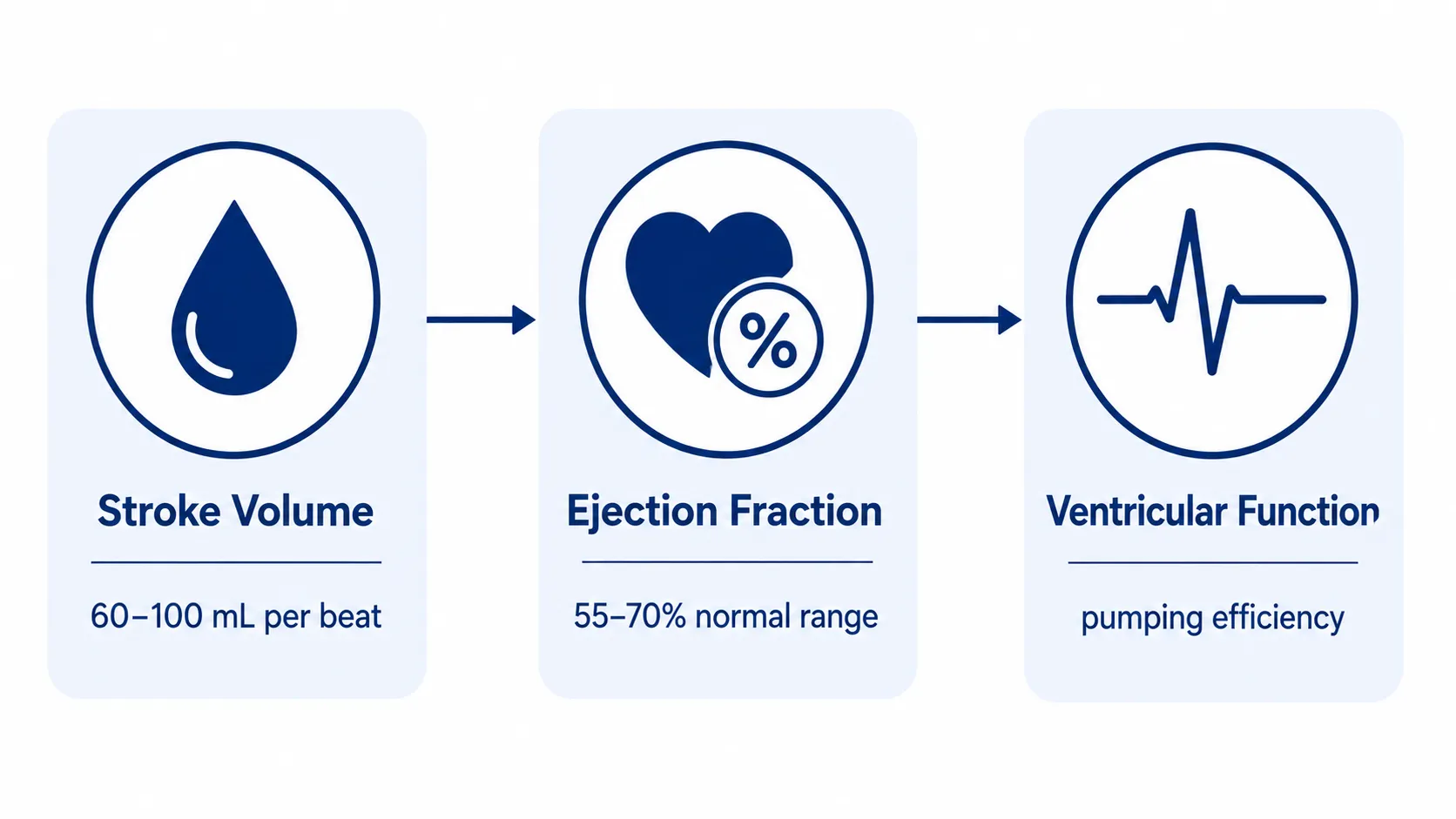
- Critical Depth to the Numbers: While cardiac output measures total blood flow per minute, Stroke Volume (SV) and Ejection Fraction (EF) provide the critical depth needed to understand true heart health.
- The Tuff Search SV Calculator: When direct clinical measurements aren’t available, this tool instantly derives stroke volume from your basic cardiac output and heart rate inputs perfect for students and fitness enthusiasts.
- Understanding Ejection Fraction (EF): This metric measures the exact percentage of blood the left ventricle pumps out with each individual contraction. A healthy, normal range sits between 55% and 70%.
- Assessing Ventricular Function: Together, ejection fraction and stroke volume paint a complete picture of ventricular function, showing exactly how powerfully and efficiently your heart’s main pumping chamber is working.
- The Hemodynamics Connection: These metrics link directly to hemodynamics the mechanical forces governing blood flow. When stroke volume drops, the heart is forced to compensate by increasing its rate to maintain adequate output. Over time, this constant compensation strains the heart muscle.
- Complete Cardiovascular View: Monitoring all three metrics together (CO, SV, and Ejection Fraction) gives you the most comprehensive view of cardiovascular performance possible without undergoing invasive clinical testing.
Frequently Asked Questions
Have questions or feedback about this calculator? Feel free to Contact Us — we’re always looking to improve your experience.
Why Use the Tuff Search Cardiac Output Calculator?
Here is what sets it apart. First, it calculates CO, cardiac index, and stroke volume in one pass no switching between tools. Second, it bridges clinical and everyday language: every result comes with a plain-English interpretation so you understand what the number means, not just what it is. Third, it covers ejection fraction context and cardiac reserve guidance that competing calculators skip entirely. Fourth, it is completely free no account, no signup, no barrier between you and your result.
Moreover, the tool works equally well for nursing students revising hemodynamics, fitness enthusiasts benchmarking cardiovascular performance, and general health readers trying to make sense of a clinical report. The Tuff Search cardiac output calculator speaks to all three audiences without dumbing down for any of them.
Your Heart Works Every Second Know Your Numbers
Two inputs. Ten seconds. A complete picture of your cardiovascular output. Use the Tuff Search Cardiac Output Calculator right now to calculate your CO, cardiac index, and stroke volume and finally understand what your heart is doing every minute of every day.