What Is a Dunk Height Calculator and How Does It Work?
A dunk height calculator is an online tool that uses your body measurements and hoop height to calculate the exact vertical jump you need to dunk a basketball. It removes all guesswork. Two inputs drive every calculation: rim height and standing reach. Together, they define your personal dunking gap.
Rim Height The Number You Are Always Jumping Toward
Rim height is fixed at 10 feet for regulation basketball, whether you’re playing in high school, college, or the NBA. This number never changes on a standard court, which makes it the one fixed variable in every calculation. However, youth leagues often use lower hoops 8 feet or 9 feet, depending on age group and skill level. Many recreational courts and driveway hoops also sit lower than regulation height.
Knowing your exact rim height matters because every calculation starts here, and a small difference in rim height changes your required vertical significantly. The calculator automatically adjusts for whichever height you select, so you always get an accurate number regardless of where you play.
Standing Reach Your Most Important Calculator Input
Standing reach is the highest point your fingertips touch while standing flat-footed, arm fully extended overhead. This number matters more than your height alone, since arm length varies significantly between players of the same height. Two players standing at exactly 6 feet tall can have standing reaches that differ by 4 or 5 inches, purely because of wingspan and torso proportions. To measure it at home, stand against a wall, reach up as high as possible without rising onto your toes, and mark the spot with chalk or tape. Repeat this two or three times to confirm accuracy, since a single measurement can be off by an inch. The standing reach calculator built into this tool then uses that exact number for your results, making your final target far more precise than a generic height-based estimate.
Understanding Dog Gestation How This Calculator Works
This tool is also known as a canine pregnancy calculator a name vets and breeders use interchangeably with dog pregnancy calculator. The two terms describe exactly the same tool: enter the mating date, get the due date.
Canine gestation refers to the full period from conception to birth approximately 63 days. Vets, however, count gestation from ovulation, not necessarily from the visible mating date. Ovulation and mating rarely happen on the same day, which is why the accepted delivery window spans day 58 to day 68.
Most home breeders do not track ovulation precisely. That is completely normal. Using the first confirmed mating date gives you a reliable estimate that falls within the safe delivery window. If you tracked multiple mating dates, use the earliest one for the most conservative due date estimate.
The canine pregnancy calculator on Tuff Search uses the standard 63-day formula and keeps the interface clean no account required, no subscription, no pop-ups. Enter the date, read the result, and move on to preparing your dog’s space.
How to Use the Tuff Search Vertical Dunk Calculator
The vertical dunk calculator takes less than a minute to use, giving you instant results personalized to your exact body. Follow these two simple steps to get your personalized dunk target:
Step 1: Enter Your Measurements
- Height & Reach: Input your total height and your standing reach (measured from the flat-footed wall test).
- Hoop Height: Select your target rim height choose the standard 10-foot regulation rim or lower youth heights (8 or 9 feet).
- Approach Type: Choose between a standing jump or a running approach, as this heavily impacts your final number.
- Note: The tool accepts both inches and centimeters, so no manual conversion is needed.
Step 2: Get Your Instant Results
Once you hit submit, the calculator instantly delivers three precise training benchmarks:
- Minimum Required Vertical Jump: (e.g., for a 6-foot player, this typically lands around 30 to 34 inches to clear the rim with the ball).
- Estimated Hang Time: How long you’ll need to stay airborne.
- Takeoff Speed: The velocity required to generate that vertical lift.
Tip: Every output updates instantly if you tweak your inputs, allowing you to see exactly how much a running start reduces your target.
What Does Your Vertical Leap Calculator Show You?
The vertical leap calculator doesn’t just give you one number it breaks down exactly what your jump needs to accomplish and why each output matters for your training.
Minimum Vertical Jump to Dunk Your Personal Target
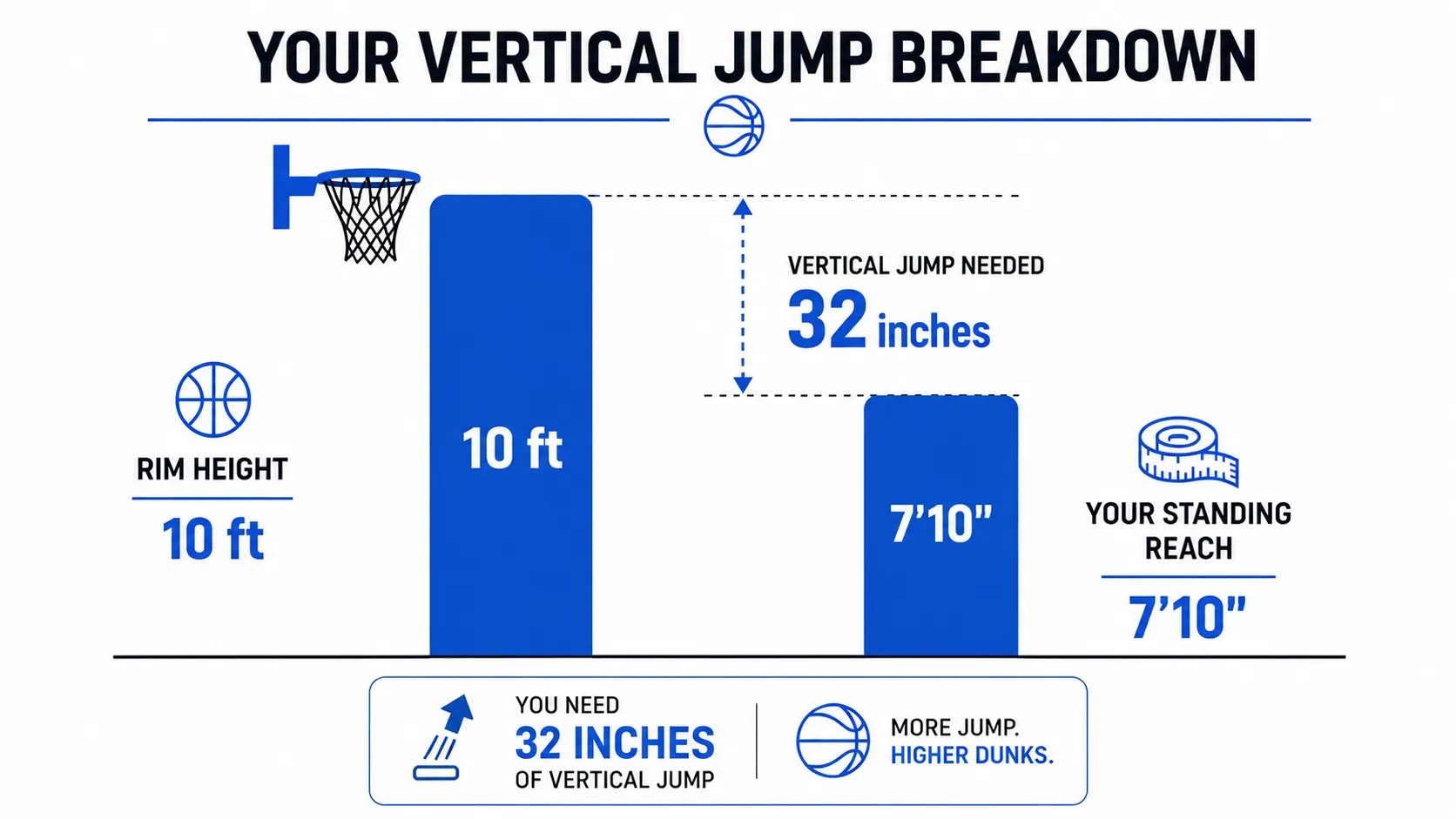
Your minimum vertical jump to dunk is calculated by subtracting your standing reach from the rim height, then adding roughly 6 inches so your hand clears the rim with the ball comfortably. For a 6-foot player with a standing reach of 7’10”, the gap to the rim alone is 26 inches. Add the clearance buffer, and the vertical jump to dunk comes out to roughly 32 inches.
This single number becomes your training benchmark moving forward, giving you something concrete to measure progress against instead of guessing whether you’re improving.
How Your Approach Type Changes Everything
Most competitors skip this entirely, but approach type changes your real number significantly, and it’s one of the most overlooked factors in dunk training. A running approach generates extra lift from momentum, often reducing your required vertical by 2 to 4 inches compared to a standing jump from a dead stop.
This means how much vertical do I need to dunk depends heavily on whether you take a running start or jump straight up without any momentum. Players training for standing dunks often need significantly more raw leg power, while players using a running approach can rely partly on horizontal-to-vertical energy transfer.The calculator adjusts your result based on which approach you select, giving you a realistic and achievable target either way.
What Affects Your Basketball Dunk Height? Real-World Examples
Basketball dunk height requirements change dramatically based on a player’s actual measurements, not just their height alone. Here is how the numbers break down in the real world:
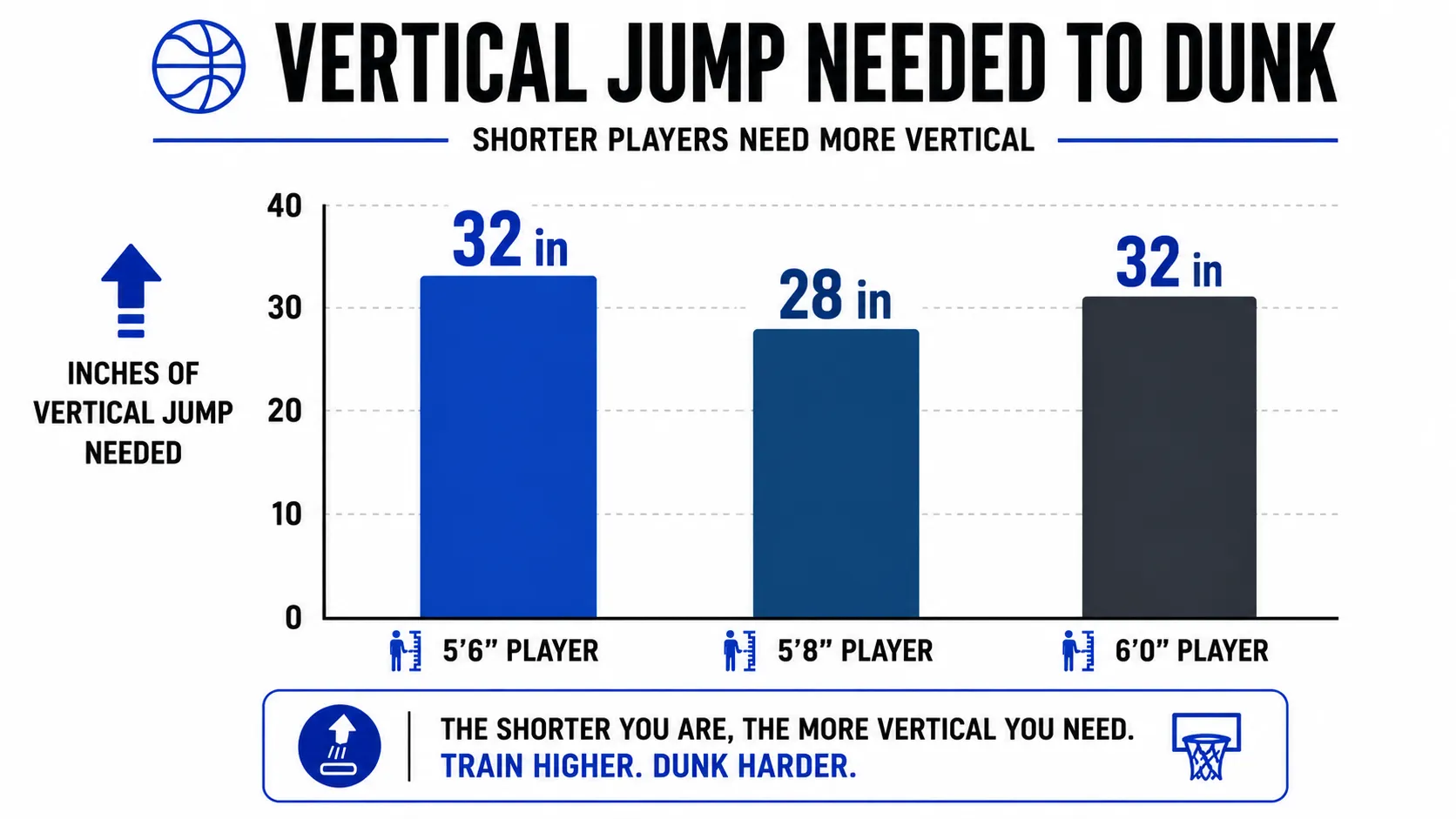
- 5’6″ (167 cm) Player: Typically needs an explosive vertical jump between 36 to 40 inches (91 to 101 cm) to dunk, as their standing reach is naturally shorter.
- 5’8″ (173 cm) Player: If you can already touch the rim at this height, your current vertical is likely around 24 to 28 inches. To comfortably dunk, you will need to push that target to around 32 to 36 inches (81 to 91 cm).
- 6’0″ (183 cm) Player: Assuming an average standing reach of 7’10”, a 6-foot player needs a 32 to 34-inch (81 to 86 cm) vertical jump to clear the rim with the ball and throw it down.
Beyond Raw Height: 3 Factors That Shift Your Target
- Arm Length (Wingspan): Longer arms directly increase your standing reach. This automatically reduces the vertical jump height you need without requiring extra training.
- Approach Type: A running start generates extra momentum, often reducing your required vertical jump by 2 to 4 inches compared to jumping straight up from a standing position.
- Palm Size & Ball Control: Players with larger hands can palm the basketball, meaning they only need to clear the rim by a couple of inches. If you have smaller hands, you may need an extra 2 to 3 inches of clearance to dunk without losing control of the ball.
Frequently Asked Questions
Have questions or feedback about this calculator? Feel free to Contact Us — we’re always looking to improve your experience.
Why Use Tuff Search Dunk Calculator?
The Tuff Search dunk calculator stands apart by providing a complete picture instead of a generic guess. In one tool, it calculates multiple outputs (vertical jump, hang time, and takeoff speed), supports both metric and imperial units, and adjusts for your approach type and hoop height from youth leagues to 10-foot regulation rims.
Ready to Measure Your Dunk Potential?
Your personal dunk target is just one calculation away. Enter your height and standing reach into the Dunk Calculator right now to find your real number and start training with a target that’s actually yours.