


Fresh concrete hardens within hours, but it is far from finished. It keeps getting stronger for weeks through a chemical reaction between cement and water called hydration. Knowing the difference between setting, drying and curing tells you when it is safe to walk on a new slab, park a car on it or lay flooring over it.
Setting, drying and curing are different things
- Setting – the change from a workable paste to a solid. Normal concrete starts to stiffen within a few hours, faster in hot weather.
- Curing – keeping the concrete moist and at a suitable temperature so hydration continues and strength builds. This is something you do, not something that just happens.
- Drying – moisture leaving the slab. Concrete can be strong long before it is dry enough for moisture-sensitive flooring such as wood or vinyl.
A typical concrete timeline
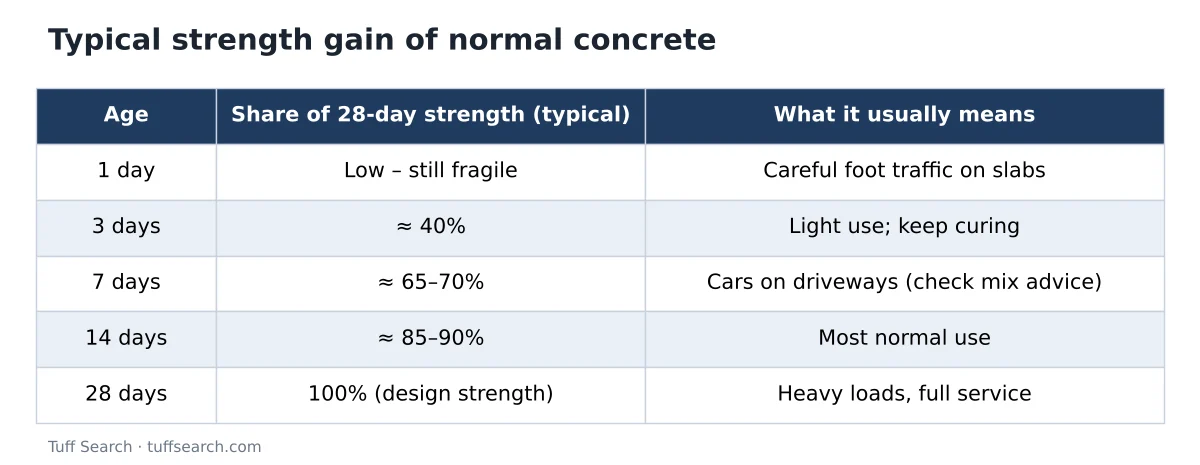
Engineers specify concrete by its strength at 28 days, which is why 28 days is quoted as ‘fully cured’. The concrete keeps gaining a little strength after that, but slowly. The percentages above are typical for ordinary concrete at around 20 °C (68 °F); fast-setting and high-early-strength mixes get there sooner, cold weather slows everything down.
When can you walk, drive and build on it?
| Activity | Typical wait (moderate weather) |
|---|---|
| Remove edge forms | 1–2 days |
| Walk on a patio or path | About 24–48 hours |
| Light furniture, foot traffic | About 3–7 days |
| Cars on a residential driveway | About 7 days |
| Heavy vehicles, trucks, RVs | About 28 days |
| Moisture-sensitive flooring | Test the slab’s moisture first |
Always check the instructions for the specific mix you used – bagged concretes print their own timings – and add time in cool weather. Avoid turning wheels on a young driveway, as tyres twisting in place can scuff the surface.
How to cure concrete properly
The first week matters most. Research published by the American Concrete Institute found that about seven days of initial moist curing greatly improved the quality and strength of the outer layer of concrete compared with letting it dry out early. Common methods are:
- Keep it damp – mist the surface with water several times a day once it has set enough not to mark.
- Cover it with plastic sheeting, weighted at the edges, to hold moisture in.
- Lay wet burlap or curing blankets and keep them damp.
- Spray on a curing compound, which forms a film that slows evaporation (check it is compatible with any later coatings).
Concrete that dries too quickly can develop surface cracking, dusting and lower strength, especially in hot, windy or sunny weather.
Hot and cold weather
- Hot weather speeds setting and evaporation. Pour early in the day, have help ready to finish quickly, and start curing as soon as possible.
- Cold weather slows hydration. Fresh concrete must not freeze; use insulated blankets, accelerating admixtures recommended by your supplier, and avoid pouring on frozen ground.
- Rain soon after pouring can damage the surface – cover the slab if rain is forecast.
How long before you can seal or paint concrete?
Many sealers and coatings require the concrete to be at least 28 days old and dry. Follow the product’s instructions and, for indoor floors, carry out a moisture test before installing flooring or epoxy coatings.
Planning a concrete job
Order enough concrete, prepare a compacted base and line up help before the pour – running short or waiting for a second batch causes weak joints. If you are comparing materials for a driveway, our guide to concrete vs asphalt driveways covers cost and lifespan, and the asphalt calculator works out tonnage for an asphalt drive.
Frequently asked questions
It sets in hours and can be walked on in about a day or two, but it reaches its design strength at about 28 days and may take longer than that to dry enough for some floor coverings.
Usually yes for careful foot traffic on a normal mix in moderate weather, but avoid dragging or dropping anything on it.
Typically after about 7 days for cars, and about 28 days for heavy vehicles.
Yes – keeping it moist for the first week (by misting or covering) helps it gain strength and reduces cracking.
It sets faster, but it also dries out faster, which can weaken it. Curing is even more important in heat.
Related calculators
Related articles
- How Much Asphalt Do I Need? Tons, Area and Thickness Explained
- Asphalt Driveway Maintenance: How to Make Your Driveway Last
- House Cleaning Checklist: Daily, Weekly, Monthly and Seasonal Tasks
Sources
- Portland Cement Association – Concrete basics
- American Concrete Institute – ‘Give It a Week: 7 Days of Initial Curing’ (abstract)


