
Gravel Calculator
Last updated
Show steps
Enter the area and depth of your project and this gravel calculator gives the volume in cubic yards and cubic metres, the weight in tons or tonnes, the number of bags and an optional cost.
How to calculate how much gravel you need
- Measure the length and width of the area (or its diameter if round).
- Decide the depth – see the depth guide below – and convert it to feet (inches ÷ 12) or metres (cm ÷ 100).
- Multiply length × width × depth for the volume. Divide cubic feet by 27 for cubic yards.
- Multiply by the density of your gravel to get the weight, because many yards sell by the ton.
- Add about 10% for compaction, an uneven base and spillage.
Example – a gravel driveway 50 ft long and 12 ft wide, 4 inches deep: 50 × 12 × 0.333 = 200 ft³. Divide by 27: 7.41 yd³. At about 1.4 tons per cubic yard that is about 10.4 tons, or roughly 11.4 tons with 10% extra. In metric: a 15 m × 3.6 m drive, 10 cm deep, is 5.40 m³ – about 8.6 tonnes at 1.6 t/m³.
Gravel coverage chart
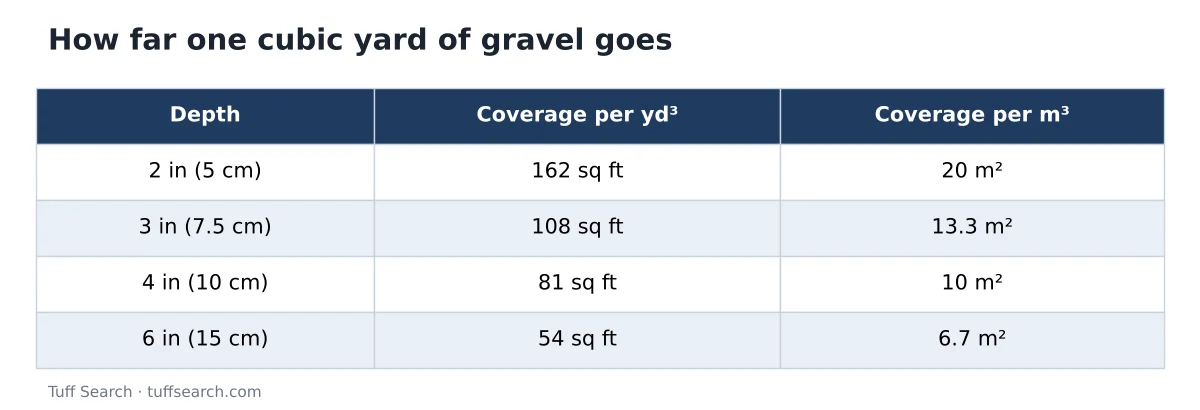
The chart works backwards too: if a supplier quotes a price per yard, divide your area by the coverage figure for your depth to see how many yards to order.
Gravel density by type
| Material | Typical density | Per cubic yard (approx.) |
|---|---|---|
| Pea gravel | 1.5–1.7 t/m³ | 1.3–1.4 short tons |
| Crushed stone (#57, ¾ in) | 1.5–1.7 t/m³ | 1.3–1.4 short tons |
| Crusher run / road base | 1.7–2.1 t/m³ (compacted) | 1.4–1.8 short tons |
| River rock | 1.5–1.7 t/m³ | 1.3–1.4 short tons |
| Lava rock | 0.8–1.0 t/m³ | 0.7–0.85 short tons |
These ranges are typical rather than exact – density changes with stone type, size, moisture and how tightly the material packs. Suppliers usually know the figure for their own products, so enter it in the custom field when you have it. One cubic yard of ordinary gravel weighing about 1.4 tons is a reasonable planning number.
How deep should gravel be?
| Project | Typical depth | Tip |
|---|---|---|
| Decorative bed or mulch replacement | 2–3 in (5–7.5 cm) | Lay over landscape fabric |
| Garden path | 3–4 in (7.5–10 cm) | Use edging to stop spreading |
| Patio or paver base | 4–6 in (10–15 cm) compacted | Crusher run compacts well |
| Gravel driveway | 8–12 in total in layers | Large stone base, medium middle, fine top |
| French drain / drainage | Depends on trench size | Use clean, washed stone |
A long-lasting gravel driveway is usually built in layers: a base of larger crushed stone, a middle layer of smaller stone, and a top layer of finer gravel that is pleasant to drive on. Run the calculator once for each layer with its own depth and material, then add the results. Compact each layer with a plate compactor or roller before adding the next.
Bags or bulk?
Gravel in bags is convenient for small jobs but expensive per yard. A common bag size is 0.5 ft³, so it takes 54 bags to make one cubic yard. The 30 ft path in the example (22.5 ft³) needs 50 half-cubic-foot bags with 10% extra – at that point bulk delivery is usually cheaper. Ask your supplier about delivery fees, minimum loads and where the truck can tip.
Tons, tonnes and yards – avoid unit mix-ups
- A US (short) ton is 2,000 lb; a metric tonne is 1,000 kg (about 2,205 lb).
- A cubic yard is 27 ft³ or about 0.765 m³.
- 'A yard of gravel' always means a cubic yard of volume, not a weight.
- If one supplier quotes per ton and another per yard, convert with the density before comparing.
Tips for a gravel project that lasts
- Remove turf and topsoil, then lay a geotextile fabric to stop gravel sinking into the soil and weeds coming up.
- Slope driveways slightly (a crown or a fall to one side) so water runs off rather than forming puddles.
- Use angular crushed stone for surfaces that carry cars – rounded pea gravel rolls underfoot and under tyres.
- Install edging (timber, steel or concrete) on paths and beds to keep gravel in place.
- Top up thin spots every year or two; gravel migrates and compacts over time.
How much does gravel cost?
Enter the price your supplier quotes – per ton, per cubic yard, per cubic metre or per bag – and the calculator converts your volume into the matching unit. Bulk gravel is usually much cheaper per yard than bagged gravel, but delivery fees can be significant for small loads, so compare the delivered total, not just the unit price. Decorative stone (river rock, coloured or polished pebbles) costs considerably more than crushed stone or road base.
Types of gravel and where to use them
| Gravel | Size / look | Best for |
|---|---|---|
| Crushed stone (#57) | About ¾ in, angular | Driveway middle layers, drainage, under pavers |
| Crusher run / road base | Mix of stone and fines | Compacted base for driveways, patios and sheds |
| Pea gravel | ⅜ in, rounded | Paths, play areas, decorative beds (not steep slopes) |
| River rock | 1–3 in, smooth | Decorative borders, dry creek beds |
| Washed / clean stone | No fines | French drains, around drainage pipes |
| Decomposed granite | Fine, sandy | Natural-looking paths and patios when compacted |
Gravel for drainage and French drains
For a French drain, calculate the trench volume (length × width × depth) and subtract the volume of the perforated pipe if it is large: a 4 in pipe takes up about 0.087 ft³ per foot of length. Use clean, washed stone so water flows freely, and wrap the trench in filter fabric to keep soil out. A 30 ft trench, 1 ft wide and 1.5 ft deep, holds 45 ft³ – about 1.7 cubic yards of stone, or a little less after allowing for the pipe.
Round and irregular areas
For a circular area, use π × radius² as the area; a fire-pit surround with a 6 ft radius covers about 113 sq ft. For curved beds, divide the shape into rectangles and triangles, or walk the outline with a measuring wheel and estimate the area, then enter it directly in the calculator's area field. Add 10% for curved edges.
How to build a gravel driveway or path step by step
- Mark the outline and dig out turf and topsoil – usually 4–8 in for paths and 8–12 in for driveways.
- Compact the soil and shape a slight crown or cross-fall so water drains off.
- Lay a woven geotextile fabric over the soil.
- Spread the base layer (larger crushed stone or crusher run) in lifts of 3–4 in, compacting each lift.
- Add the middle and top layers, compacting each one; finish with the decorative or fine top gravel.
- Fix edging along the sides so the gravel stays in place.
Run the gravel calculator once for each layer with its own depth and material, then add the tonnages. Ordering each material separately avoids paying decorative-stone prices for the hidden base.
Maintaining gravel surfaces
- Rake ruts and potholes level every few months; fill deep holes with base stone before topping up.
- Add a thin top-up layer (about 1 in) every year or two.
- Clear leaves and debris so they do not rot into soil that lets weeds grow.
- Keep drainage ditches and culverts clear to stop washouts after heavy rain.
Sources
- U.S. Federal Highway Administration – Highway Materials Engineering Course: Aggregates (PDF) — fhwa.dot.gov/pavement/materials/hmec/pubs/module_d/lesson02_is.pdf
- NIST – Guide for the Use of the International System of Units (SI) — nist.gov/publications/guide-use-international-system-units-si
Results are estimates for general information. Last reviewed: .

Written & built by
Zeeshan Nawaz
Calculator Developer · Tuff Search
Builds and tests Tuff Search calculators, turning published formulas and official sources into tools anyone can check.
FAQ
Frequently asked questions
Quick answers about the Gravel Calculator.
About 1.4 short tons (2,800 lb) for typical gravel, but it ranges from roughly 1.3 to 1.8 tons depending on the material.
At 2 inches deep, about 115 sq ft per ton (162 sq ft per yard ÷ 1.4 tons). At 4 inches, about 58 sq ft per ton.
Multiply length × width × depth in feet, divide by 27 and multiply by about 1.4. A 50 × 12 ft drive at 4 inches needs about 10 tons per 4-inch layer.
54 bags of 0.5 ft³, or 27 bags of 1 ft³.
Measure in metres: length × width × depth. Multiply by about 1.6 to estimate tonnes.
Yes. Crushed stone that will be compacted usually needs 10–15% more loose material than the finished volume.
Still have a question? Email support@tuffsearch.com
Keep exploring
Related calculators
More calculators people use alongside this one.
Zeeshan Nawaz
Calculator Developer · Tuff Search
Builds and tests Tuff Search calculators. Each tool is based on published formulas and official sources, and is checked against worked test cases before it goes live.
- Gravel CalculatorConstructionYou are here
- Dog Age CalculatorBiology
- Fuel Cost CalculatorDaily Life